Today’s customers have high expectations of delivery, so many businesses have no choice but to invest in last-mile logistics.
What is the last mile (a simple definition of last-mile logistics)
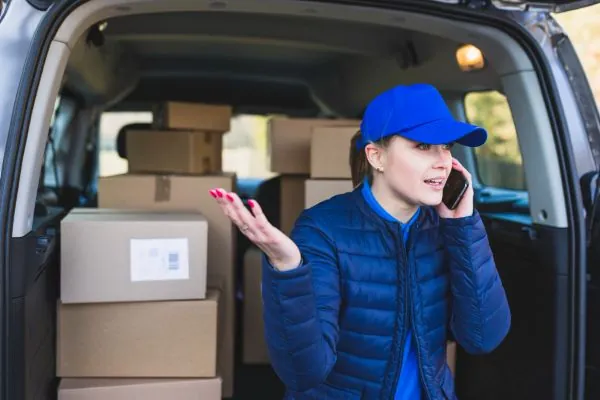
Last-mile delivery is the final stage of the logistics chain, often considered the most important for the customer experience. After all, it is the final step in transportation, when the goods reach the customer directly from the warehouse or sorting center.
Last-mile delivery is critical for the following businesses:
- online stores and e-commerce;
- retail and chain stores;
- manufacturing companies;
- brands with expensive and fragile goods.
In general, a well-coordinated last-mile delivery is essential in environments with tight deadlines, high downtime costs, and a targeted customer.
How last-mile delivery works: stages and who is involved
Last-mile delivery occurs after the goods arrive in the destination country and clear customs.
What are the steps involved in last-mile delivery?
- The order is processed and prepared for shipment;
- Delivery is planned (address, time, and date);
- Transportation is provided and a carrier is assigned;
- The goods are loaded;
- The actual delivery occurs;
- The goods are handed over directly to the customer.
Therefore, the “last mile” must include warehouse coordination, precise timing, and synchronization of all transport.
Who participates in last-mile delivery:
- Online stores and retail companies;
- Logistics and transport companies;
- Customers (recipients);
- Couriers/drivers.
Throughout all stages, responsibility for the cargo is transferred, and direct contact with the customer occurs. For example, through the courier or order tracking system.
Last-mile delivery formats: door-to-door, pickup point (POP), parcel terminals, delivery within a time window
To select a delivery method tailored to the needs of a specific business, consider the type of cargo, budget, delivery time, and destination.
What are the different types of last-mile logistics:
- “door to door”;
- from a customs warehouse/terminal to the customer’s door;
- from one terminal to another;
- Pickup point (PO) – order pickup point;
- parcel lockers;
- delivery to a temporary terminal (an agreed-upon time window).
The main formats are delivery from courier to customer (B2C) and from supplier to business (B2B). Door to door delivery is the most common option, as it is suitable for both B2B and B2C. It also requires minimal customer interaction, even with regular deliveries. For stores, shopping malls, and offices, intermittent delivery is suitable, while for small parcels, pickup points and parcel lockers are more cost-effective.
The last-mile challenge: why is this the most challenging stage?
What makes last-mile logistics challenging:
- Delays most often occur at the last mile;
- the risk of additional costs (queues, toll zones, late fees) increases;
- The risk of ruining the overall delivery experience.
The problem with the last mile is that the entire previous delivery process—sea, rail, and customs—could have been perfectly organized. However, if the last mile is poorly planned, there’s a risk of completely disrupting the delivery.
Challenges that may arise when organizing last mile delivery include:
- inaccurate or problematic addresses;
- time constraints and time slots;
- city traffic;
- restrictions for large vehicles;
- poor communication—unfortunately, the human factor is always present.
Customers expect exceptionally cheap, fast, and convenient delivery. Otherwise, they will switch to competitors and never return to the brand’s products or services.
How to Improve Last Mile Logistics: Practical Solutions
To optimize last mile delivery, it’s no surprise that logistics professionals are using modern technologies. For example, there are warehouse management systems (WMS) and transportation management systems (TMS).
Of course, the surest way to improve last-mile delivery is to outsource it to a logistics company. This way, you can achieve results with minimal impact, and always have a plan B, SLA, and analytics in place.
However, some practical steps can already be taken to optimize last-mile delivery:
- analyze all causes of failures and delays;
- monitor and record loading/unloading;
- implement time-based delivery and coordinate time slots;
- provide as complete address information as possible.
Last-mile delivery has a major paradox: it’s the shortest, but ultimately the most expensive.
KPIs: How to Know if Last-Mile Delivery is Working Well
Last-mile delivery can only be considered successful if it meets the following metrics: speed, efficiency, and optimal cost.
When choosing a last-mile partner or analyzing your own delivery, you should rely on the following metrics:
- how many deliveries were completed on the first try, without a second trip;
- Average delivery time;
- Cost;
- Are there any missed deliveries?
- What is the customer contact history?
- Has there been any damage to the shipment?
For effective achieving lasting and long-term improvement requires systematic work, not ad hoc solutions. Therefore, a comprehensive strategy is essential for last-mile logistics. KPI analysis will help identify supply chain bottlenecks, more accurately calculate costs, and improve service and customer experience.
Conclusion
Only the last mile determines whether the customer will receive the cargo on time and without any issues. There is minimal room for error here, so standardization and synchronization are essential. This is why businesses are increasingly outsourcing the final stage of delivery to logistics companies rather than doing everything manually. Professional logisticians are better able to manage risks, time, and product liability.
How a logistics company improves last-mile delivery for a business:
- selects the right transport;
- develops the fastest and cheapest route;
- takes charge of the entire transportation organization, even before the cargo is released;
- coordinates all participants: warehouse, driver, partners, recipients;
- significantly reduces costs and the number of repeat deliveries;
- controls loading, unloading, labeling, and warehousing.
A transport and logistics company takes on the very components that make the “last mile” complex, making it manageable and accessible. The company achieves high-quality and predictable results: fast delivery with clear communication and transparent costs.