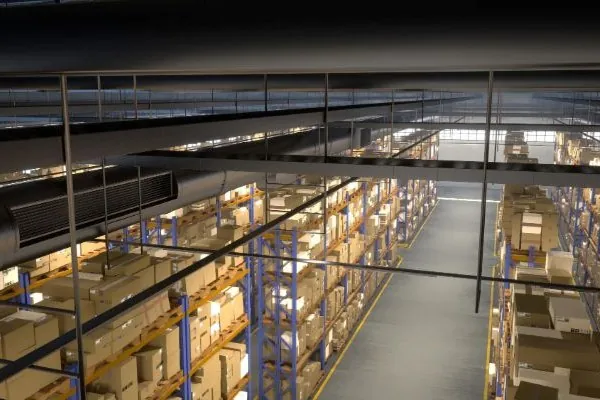
Warehouse processes are an important stage of business development that any entrepreneur comes to over time. After all, this directly affects the appearance and quality of products, as well as reputation and customer experience. So let’s consider how the warehouse is organized.
Warehouse logistics is: a simple definition and the role of a warehouse in the supply chain
Warehouse logistics is a system of all processes related to goods in a warehouse. This includes their placement, storage, assembly and timely shipment.
Warehouse logistics is not only about storing goods. It is also about effective management of product flows and balances, as well as fast order processing.
Warehouse logistics is critically important for business profitability, because it determines:
- quality and quantity control of goods;
- efficiency of document flow;
- speed and quality of the enterprise’s work during the peak season;
- prevention of damage and losses;
- level of customer service.
In short, the main task of warehouse logistics is to ensure that the goods are delivered on time, to the right place and in the right quantity.
Warehouse logistics and warehousing: what is included in the concept and how they differ
Warehouse logistics and warehousing are similar concepts of general logistics, but they have a certain difference.
What do the concepts mean:
- warehouse logistics is the management of absolutely all processes that occur in the warehouse;
- warehousing is only the actual and physical storage of goods in the warehouse.
Conclusion: warehousing is an element of warehouse logistics. Without it, the goods will not be correctly placed on shelves or pallets, and also stored in their integrity. Warehouse logistics will ensure quick and unhindered finding of goods among many others.
Logistics warehouse: what zones and resources are needed for stable operation
For the stable operation of a logistics warehouse, it must necessarily have the following areas:
- reception – entry point;
- storage – key zone;
- marking;
- picking – order collection;
- packaging;
- shipping – exit point;
- return or write-off.
Of course, the organization of warehouse work is impossible without personnel, equipment, instructions and a certain system.
What personnel is needed for warehousing logistics:
- storekeepers;
- pickers;
- forklift operators;
- warehouse managers.
The warehouse organization may also have additional specialized areas. For example, refrigeration and freezer rooms, areas for dangerous goods (ADR), offices and staff rooms.
Different types of warehouses are suitable for different products:
- dry warehouses – for goods that do not require special conditions;
- warehouses with temperature regime – for objects that require special storage conditions;
- temporary storage warehouses – for short-term placement of goods;
- customs warehouses – for parcels under customs control, for which payment of customs payments and customs clearance are still expected.
There is also an international classification of warehouses, denoted by the letters A, B and C. Of these, A is the most modern and technically equipped.
Warehouse processes: what does the full cycle look like
Warehouse logistics combines all participants in the chain into one managed process – carriers, customs officers, partners and customers. Therefore, the processes must be adjusted and synchronized with each other.
In general, the full cycle of warehouse processes is the same in organized and experienced logistics companies:
- receipt of goods;
- control and labeling;
- placement;
- accounting;
- storage;
- selection of goods;
- order picking;
- packaging;
- order consolidation;
- shipment;
- return (if necessary).
What is included in comprehensive solutions for organizing warehouse operations:
- selection of a suitable warehouse space;
- placement in a warehouse;
- storage with round-the-clock control;
- loading and unloading;
- packaging, labeling and consolidation of goods;
- processing and shipping orders.
Warehouse processes are a continuous chain, where each stage affects the next.
Warehouse operations: what they are and what actions are performed daily
Warehouse operations are logistics processes that occur on the territory of the warehouse to ensure the smooth functioning of the supply chain.
What warehouse processes are performed daily:
- unloading transport and checking the goods in it, in particular by means of reconciliation with invoices;
- applying barcodes and other markings, entering data into the accounting system;
- placing goods in storage areas;
- monitoring compliance with storage conditions;
- checking actual availability and minimum balances;
- grouping goods;
- forming orders;
- selecting and carrying out packaging;
- marking sent orders;
- processing documents and transferring them;
- loading transport;
- consolidating orders;
- checking the condition of goods;
- accepting returns, re-placing or writing off.
Also, in the organization of the warehouse, tasks occur every day that customers may not track, because the warehouse owner is responsible for them. These include cleaning the premises, ensuring security, time recording and communication with carriers or logistics.
Warehouse organization: placement of goods, rules and regulations
The basis of stable warehousing logistics is provided by daily discipline and clear processes.
Every logistics warehouse begins with detailed instructions. Usually, safety rules are as follows:
- staff must undergo training, for dangerous goods – special training;
- it is necessary to use special clothing;
- aisles must be free for comfortable movement;
- accounting must be clear – documents, reports and their compliance;
- all warehouse areas must be clearly defined;
- equipment must be regularly checked;
- placement must be logical: heavy loads – on the lower tiers, lighter ones – on the upper ones;
- each warehouse operation must have a responsible person;
- acceptance and shipment must be carried out in compliance with standards.
Without following the instructions, the warehouse will quickly become a source of losses and chaos. Therefore, it is worth entrusting your goods and their delivery to proven and experienced logistics companies with warehouses.
Warehouse optimization: what gives the greatest effect without high costs
Warehouse optimization helps to process orders much faster and better, and most importantly, reduce warehousing costs.
What ensures warehouse optimization:
- placement of goods according to the ABC-XYZ analysis principle;
- use of modern IT warehouse management systems (WMS);
- automation instead of manual labor (minimize it);
- correct planning of zones, flows and selection.
If you implement at least some of these tools, it will turn out that the warehouse does more, while spending less.
Conclusion
It is worth entrusting warehousing to responsible and reliable logistics companies, because the condition of the goods and the stable operation of the company even during seasonal peaks depend on this.
The transport and logistics company TVL has modernly equipped warehouses in Kyiv and Kyiv region, as well as a wide network of partners in Europe.
Advantages of warehousing services from TVL:
- cargo protection and safety;
- access control;
- warehouse management system WMS;
- temperature and humidity control;
- fire and ventilation systems.
Prices for warehousing services are formed depending on the type and volume of cargo. However, TVL always offers flexible terms of cooperation for each client, and most importantly – reliable warehousing with constant supervision.